What Regulators Expect Firms to Know About the Stages of Money Laundering

Financial crime continues to evolve, making anti-money laundering programs a top priority for regulators worldwide. Whether a business operates in banking, fintech, insurance, or payment services, regulators expect organizations to understand the stages of money laundering and implement controls that reduce financial crime risks.
A strong understanding of how illicit funds move through the financial system is essential for maintaining effective AML compliance and avoiding regulatory penalties.
Understanding Money Laundering
Before examining regulatory expectations, it is important to answer a common question: What is money laundering with example?
Money laundering is the process of disguising illegally obtained funds to make them appear legitimate. A simple money laundering example involves a criminal depositing cash generated from illegal activities into a business that handles large amounts of cash. The funds are then moved through various transactions before being reintroduced into the economy as seemingly lawful income.
Regulators expect firms to identify such patterns and maintain systems capable of detecting suspicious activities before illicit funds enter the financial system.
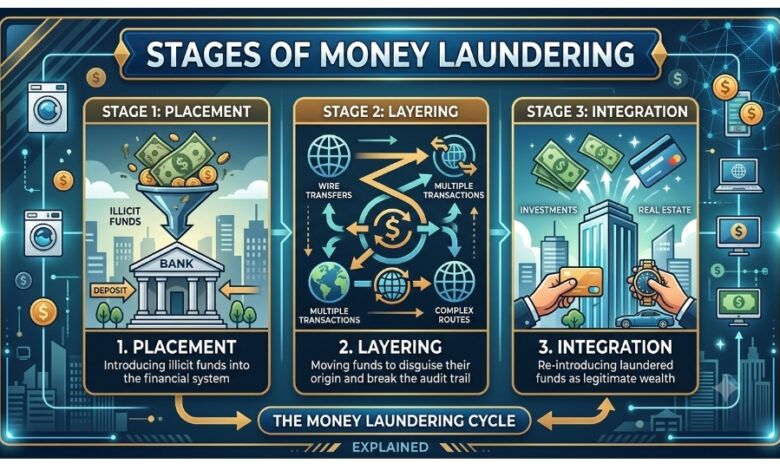
The 3 Stages of Money Laundering
Every compliance professional should understand the stages of money laundering, as they form the foundation of most regulatory guidance and AML frameworks.
Placement
Placement is the initial stage where illegally obtained funds enter the financial system. Criminals may use cash deposits, money orders, or business transactions to introduce illicit funds into circulation.
Regulators expect organizations to monitor unusual deposits, large cash transactions, and customer activities that do not align with known business profiles.
Layering
Layering involves creating multiple transactions to obscure the origin of funds. This stage often includes transfers between accounts, international transactions, and complex financial arrangements designed to confuse investigators.
Financial institutions are expected to use transaction monitoring systems and risk-based controls to identify unusual movement of funds.
Integration
Integration occurs when laundered funds are reintroduced into the legitimate economy. At this stage, the money may be used for investments, property purchases, or business ventures.
Regulators expect firms to conduct ongoing due diligence and identify transactions that appear inconsistent with a customer’s financial history.
What Regulators Expect from Firms
Regulatory agencies focus on more than understanding theory. They expect organizations to apply knowledge of laundering methods to real-world risk management practices.
Key expectations include:
- Implementing risk-based customer due diligence procedures
- Monitoring transactions for suspicious patterns and unusual behavior
- Maintaining accurate records and audit trails
- Training employees to recognize financial crime indicators
- Reporting suspicious activities to relevant authorities
Failure to meet these expectations can result in substantial fines, reputational damage, and increased regulatory scrutiny.
Learning from Fraud and Financial Crime Cases
High-profile financial scandals often influence regulatory guidance. One notable example is the Wirecard fraud, which exposed weaknesses in governance, oversight, and financial reporting. Although the case primarily involved accounting misconduct, it highlighted the importance of transparency and effective compliance controls.
Regulators frequently examine whether firms have adequate systems to detect irregular activities before they develop into larger financial crime risks.
Understanding employee misconduct is equally important. Many organizations study embezzlement meaning and internal fraud risks as part of their compliance programs. Embezzlement refers to the theft or misappropriation of funds entrusted to an individual. Common embezzlement examples include employees diverting company funds into personal accounts or manipulating financial records to conceal theft.
These cases demonstrate why internal controls play a critical role in preventing both fraud and money laundering activities.
The Role of the Fraud Triangle Theory
Another concept regulators expect firms to understand is the fraud triangle theory. This framework explains that fraud often occurs when three factors are present:
- Pressure
- Opportunity
- Rationalization
Employees or third parties experiencing financial pressure may exploit weak controls if opportunities exist. They may then justify their actions through rationalization. By recognizing these risk factors, organizations can strengthen governance structures and reduce vulnerabilities.
The fraud triangle remains a useful tool for compliance teams when assessing operational and financial crime risks.
Strengthening AML Compliance Programs
Modern compliance programs require more than basic monitoring. Regulators increasingly expect firms to adopt proactive approaches that address emerging threats and changing criminal techniques.
Effective AML compliance involves continuous risk assessments, employee training, enhanced due diligence, and advanced monitoring technologies. Organizations should regularly review their controls to ensure they remain aligned with evolving regulatory expectations.
Conclusion
Regulators expect firms to have a thorough understanding of the stages of money laundering and apply that knowledge through effective risk management practices. Recognizing the placement, layering, and integration process helps organizations detect suspicious activity earlier and strengthen their compliance framework.
By understanding concepts such as what is money laundering with example, learning from cases like Wirecard fraud, studying embezzlement examples, and applying the fraud triangle theory, firms can build stronger defenses against financial crime while maintaining regulatory compliance.