M6 Walsall Birmingham Lanes Closure: The Real Reason Drivers Are Facing Delays

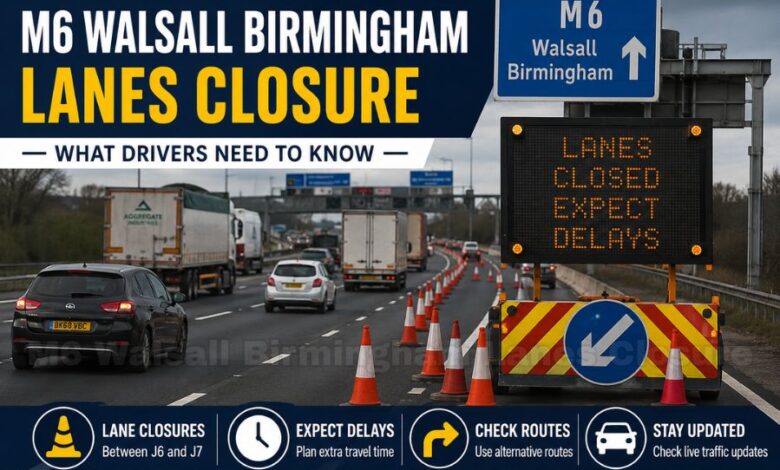
The M6 Walsall Birmingham lanes closure has become a major concern for drivers because this is not just another stretch of motorway. It is one of the most pressured transport corridors in the West Midlands, linking Birmingham with Walsall and carrying a constant mix of commuters, commercial traffic, and long-distance vehicles. Official government material describing the M6 between Junctions 5 and 8 calls it a heavily congested link that carries major strategic flows through Birmingham, with peak journey times historically running around 55% to 65% higher than free-flow conditions. That helps explain why even a single lane restriction in this area can quickly turn an ordinary journey into a frustrating crawl.
For many people, the phrase m6 walsall birmingham lanes closure sounds like a sudden traffic problem, but in reality it usually refers to planned maintenance, lane restrictions, safety works, resurfacing, bridge repairs, or occasional emergency disruption on the section around M6 Junction 6 in Birmingham and Junction 7 at Great Barr. This area is especially sensitive because it sits near one of the busiest motorway approaches into Birmingham, while also feeding traffic toward Walsall through the A34 corridor. The RAC specifically identifies Junction 7 as a common hotspot because it connects with the A34, the main road between Birmingham and Walsall, where heavy traffic and slip-road merging frequently cause delays.
Why the M6 Walsall Birmingham Lanes Closure Happens
The most important thing drivers should understand is that these closures are usually not random. They are often part of essential infrastructure work designed to keep a very busy motorway safe and usable. National Highways’ official West Midlands maintenance page shows that one of the most important recent schemes in this corridor was the M6 junction 6 to 7 bridge joint replacement, scheduled from 7 April to 13 May 2026. According to the official closure plan, the works included a full northbound closure between Junction 6 and 7 from 7 April to 24 April, a full southbound closure between Junction 7 and 6 from 27 April to 6 May, and a further full northbound closure from 7 May to 13 May 2026. National Highways also warns that closure arrangements can change at short notice, which is why drivers should always treat online articles as guidance and check official updates before setting off.
That closure schedule shows something important. The issue is not simply “traffic for no reason.” It reflects engineering work on a critical route. Bridge joints may not sound dramatic, but they are vital components on heavily used structures, especially on major motorway sections where heavy vehicles pass constantly and surfaces expand and contract with weather and temperature changes. If those components are not repaired or replaced on time, the motorway can deteriorate further and force even more disruptive emergency restrictions later. In that sense, the M6 Walsall Birmingham lanes closure is frustrating in the short term, but it is often designed to prevent a much bigger problem in the future.
Why This Stretch of the M6 Feels Worse Than Other Closures
Drivers often feel that closures in this area are more stressful than closures elsewhere, and there is a clear reason for that. The route between Birmingham and Walsall is already operating under pressure before any cones or barriers appear. The government’s post-opening evaluation of the M6 Junction 5 to 8 smart motorway section describes the M6 as a national artery linking major regions of the country and notes that the route also serves important connections across the Midlands. In other words, this motorway is carrying far more than just local traffic. It is a strategic corridor, which means any restriction affects both regional travel and wider journeys passing through the network.
The design of the route also adds to the problem. Around Birmingham, the M6 is not a simple straight road with easy escape options. It connects with several major routes, handles complex movements near Junction 6, and then pushes traffic toward Junction 7, where vehicles heading for Walsall and the A34 must mix with through traffic. The RAC’s traffic guidance highlights this part of the motorway as one of the worst junction areas on the M6 because of heavy flows and merging pressure. When you combine that with planned roadworks or lane closures, traffic does not just slow down a little. It can become unreliable, unpredictable, and exhausting for drivers who need to arrive at work, school, appointments, or delivery points on time.
Recent Closure Activity Around Walsall and Birmingham
Much of the recent attention around the m6 walsall birmingham lanes closure has been tied to the National Highways bridge-joint replacement scheme on the stretch between Junction 6 and Junction 7. Because the scheme was scheduled through 13 May 2026, it became a major talking point for drivers moving between Birmingham and Walsall during April and early May. The official National Highways daily closure report also notes that planned closures are listed ahead of time and that most generally run overnight unless the works last longer than twelve hours. That detail matters because drivers often assume every closure is a full daytime shutdown, when in reality some disruption follows a controlled schedule.
At the same time, motorway traffic in this corridor cannot be separated from the wider local road picture. Walsall Council states that roadworks across the borough can involve closures, diversions, and temporary traffic lights, and it directs users to the one.network map for current activity. The council also notes that the M6 and A5 are maintained by National Highways, while separate works such as the A34 Sprint project are relevant to travel between Walsall and Birmingham. This means a driver trying to avoid motorway delays by leaving the M6 early may still run into congestion or restrictions on nearby local routes. That is one reason diversions do not always feel like a real escape.
How the Closure Affects Everyday Travel
The most obvious effect of the M6 Walsall Birmingham lanes closure is longer journey time, but the deeper problem is uncertainty. Drivers can sometimes accept a delay if it is predictable. What causes real frustration is not knowing whether a journey will take twenty minutes or fifty. On a route that is already known for congestion, closures can make every trip feel like a gamble. For commuters, that means leaving earlier than normal. For tradespeople and delivery drivers, it can mean missed slots and knock-on delays for the rest of the day. For families, it can turn routine school or appointment travel into a stressful experience.
There is also the spillover effect. Once drivers begin trying to avoid the motorway, nearby roads take the pressure. Junction 7 is especially important here because of its link with the A34 between Birmingham and Walsall. If motorway traffic starts diverting through Great Barr and surrounding local routes, the congestion spreads beyond the M6 itself. That is why some people experience the closure as a wider regional traffic problem rather than a motorway-only issue. The roadworks may begin on the M6, but the consequences can be felt on approach roads, roundabouts, and alternative routes across the area.
What Drivers Should Do Before Setting Off
The smartest way to deal with the m6 walsall birmingham lanes closure is not to guess. Drivers should check official information first. National Highways provides both a West Midlands maintenance page and a daily closure report, and those sources are the best place to see planned restrictions and whether a closure is scheduled to run overnight, for a weekend period, or for a longer block of time. Because National Highways says plans can change at short notice, this check matters even for drivers who use the road regularly and think they already know what to expect.
It also helps to think beyond the motorway itself. Walsall Council’s roadworks information and one.network mapping can show whether local fallback routes are also under pressure. That matters because many drivers lose time by leaving the motorway too quickly and joining roads that are already slowed by other works or local congestion. In practical terms, the best journey is not always the most obvious diversion. Sometimes it is better to delay departure slightly, travel outside the peak, or stick with the managed route rather than trying to outsmart a closure only to get trapped on an equally busy local corridor.
Will the M6 Walsall Birmingham Lanes Closure Keep Coming Back?
The honest answer is yes, from time to time. This corridor is old, heavily used, and strategically important, which means maintenance will always be necessary. National Highways’ maintenance programme for the West Midlands makes clear that this motorway network is subject to continuing works, while the historic government documents about the M6 Junction 5 to 8 route show that congestion and infrastructure pressure in this section are not new problems. That does not mean the motorway is permanently broken. It simply means it is one of those routes where drivers should expect periodic intervention, especially when structures, joints, barriers, or surfaces need attention.
For regular users, the best mindset is realistic rather than emotional. Instead of treating every closure as a shocking event, it is better to view this stretch of the M6 as a road that will occasionally require controlled disruption to stay safe and functional. That does not remove the inconvenience, but it does make planning easier. When drivers understand that the route is sensitive and high-pressure by nature, they are more likely to check updates, allow extra time, and avoid making a stressful situation even worse through poor timing or rushed decisions.
Conclusion
The m6 walsall birmingham lanes closure is not just a traffic nuisance. It is the result of essential work on one of the busiest and most heavily loaded motorway sections in the West Midlands. Recent official closures between M6 Junction 6 and Junction 7 were linked to bridge-joint replacement, showing that the disruption had a clear engineering purpose. Because this corridor already suffers from heavy traffic and difficult junction pressure, even planned works can create major delays for drivers travelling between Birmingham and Walsall. The best response is not panic or guesswork. It is simple preparation: check official National Highways information, understand that nearby local routes may also be affected, and allow extra time whenever this part of the motorway is under restriction. With the right planning, the road may still be slow, but the journey becomes much easier to manage.
(FAQs)
What does m6 walsall birmingham lanes closure mean?
It usually refers to lane restrictions, roadworks, or carriageway closures affecting the M6 between Birmingham and Walsall, especially around Junction 6 and Junction 7. Recent official works in this stretch included a bridge-joint replacement scheme managed by National Highways.
Why are lanes closed on the M6 near Walsall and Birmingham?
The most common reasons are planned maintenance, structural repairs, resurfacing, bridge-joint replacement, or emergency incidents. National Highways’ recent works between Junction 6 and 7 show that closures are often linked to essential engineering rather than random disruption.
Which M6 junctions are most affected in this area?
The most discussed section is usually between Junction 6 in Birmingham and Junction 7 at Great Barr, where traffic heading toward Walsall and the A34 meets major motorway flows. RAC identifies Junction 7 as a regular hotspot for congestion.
How can I check if the closure is active before travelling?
Use the National Highways West Midlands maintenance page for scheme information and the daily closure report for planned closures. It is also useful to check Walsall Council’s roadworks information for local route disruption.
Will this route keep having closures in the future?
Most likely yes, at intervals. This is a heavily used strategic motorway section, and official maintenance programmes show that periodic work is part of keeping it safe and reliable over the long term