Eagles Rookie Trade Attempt: Why Philadelphia Moved Up for Jihaad Campbell in the 2025 NFL Draft

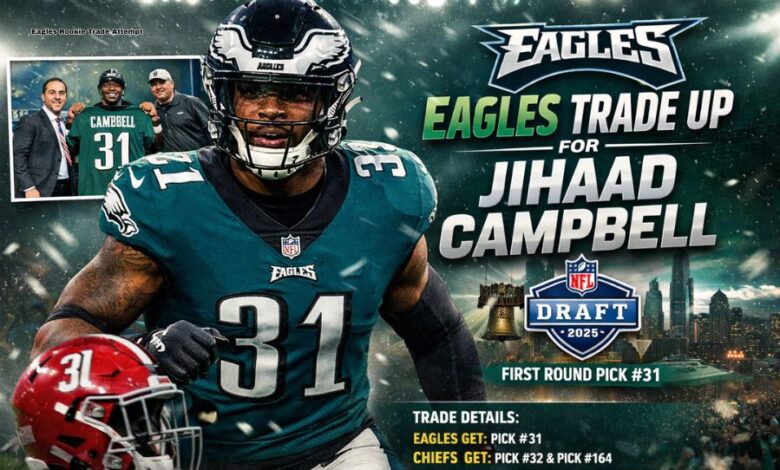
The Eagles Rookie Trade Attempt became one of the most intriguing storylines of the 2025 NFL Draft because it revealed how Philadelphia approaches roster building when conviction meets opportunity. The Eagles did not make a dramatic jump across the board, nor did they overpay to chase a headline. Instead, they made a targeted move from pick No. 32 to pick No. 31, trading with the Kansas City Chiefs so they could select Alabama linebacker Jihaad Campbell. According to the Eagles’ official announcement and ESPN’s draft coverage, Philadelphia sent the No. 32 pick and the No. 164 pick to Kansas City to secure Campbell one spot earlier. That small move carried a larger message: the Eagles believed they had a premium defensive talent within reach, and they were not willing to leave the outcome to chance.
What made the move especially notable was that it reflected a familiar Philadelphia formula: patience first, aggression second, but only when the value made sense. The Eagles already held the final pick of the first round, so they were not in a desperate position. Yet the front office clearly felt that Campbell was a player worth protecting from the uncertainty of the final moments of Round 1. Team reporting later described him as a Top-10 player on the Eagles’ draft board, while ESPN reported that general manager Howie Roseman had tried to move up earlier in the round as well. That detail is important because it shows the trade was not an impulsive decision. It was the final step in a longer pursuit of a player Philadelphia truly wanted.
Why Jihaad Campbell Was Worth the Move
The center of the Eagles Rookie Trade Attempt was not the trade itself, but the player Philadelphia believed it was getting. Campbell arrived from Alabama with the kind of profile that attracts serious first-round attention. He played 35 games, made 21 starts, and finished his college career with 184 tackles, 15.5 tackles for loss, 5.5 sacks, two interceptions, and two forced fumbles. In 2024, he earned first-team All-SEC honors after leading Alabama with 117 tackles, while also posting 11.5 tackles for loss and five sacks. Those are not just strong numbers on paper. They show a defender who produced consistently in one of the toughest environments in college football and proved he could affect games in multiple ways.
Campbell’s appeal to Philadelphia went beyond raw production. He offered something the modern NFL values deeply: versatility. ESPN’s draft analysis said the Eagles were adding a defender who could help in several roles, while the Eagles’ own coverage emphasized that he was viewed as more than a traditional off-ball linebacker. For a team that wants flexible defenders in a scheme shaped by Vic Fangio’s preference for adaptable personnel, Campbell checked a lot of boxes. He could flow sideline to sideline, play downhill, and offer pass-rush utility when needed. That kind of fit matters because draft decisions are rarely about talent alone. They are about how that talent translates inside a specific system, and Campbell looked like a natural match for what Philadelphia wanted to build on defense.
How the Trade Happened on Draft Night
On the surface, moving up one pick may seem minor, but in the NFL Draft even a one-spot jump can carry major consequences. The Chiefs owned pick No. 31 and the Eagles were sitting at No. 32. Rather than wait and hope their preferred target survived one more selection, Philadelphia gave up a fifth-round pick to control the final choice before the first round ended. That is a meaningful distinction because it shows the Eagles were not merely comfortable with Campbell; they were convinced enough to spend additional capital to secure him. The trade was modest, but it was purposeful. In draft strategy, small moves often reveal the clearest truths about a team’s board. Philadelphia’s move told everyone that Campbell was not a fallback plan. He was the player they wanted.
There is another reason this detail matters. The first round is where contracts, expectations, and organizational identity all carry extra weight. By moving into the No. 31 slot, the Eagles made Campbell a first-round investment and attached that level of belief to him. The team later described the pick as a “no-brainer,” and Roseman repeated that Campbell had been graded extremely highly on their board. That language matters because front offices are usually careful with public praise. When a general manager says a player was a Top-10 talent for his team and then trades up to take him at No. 31, it becomes clear that the decision was built on deep internal conviction rather than public consensus.
Why the Move Was Bigger Than One Pick
The Eagles Rookie Trade Attempt mattered for another reason as well: it signaled a notable shift in Philadelphia’s willingness to invest premium draft capital at linebacker. According to the Eagles’ official draft coverage, Campbell became the franchise’s first off-ball linebacker selected in the first round since Jerry Robinson in 1979. That is not a minor historical footnote. It shows how unusual this selection was for the organization. Philadelphia has not often treated that position as a first-round priority, which means Campbell had to be seen as an exception rather than a routine choice. When a franchise breaks a decades-long pattern, it usually reflects more than need. It reflects belief in a player’s quality, upside, and fit.
The move also had local resonance. Campbell is from Erial, New Jersey, making him a South Jersey product coming home to play for one of the region’s most passionate franchises. That hometown angle does not make the pick more correct from a football perspective, but it added another layer to the story. Philadelphia was not simply drafting a highly regarded Alabama defender. The Eagles were also bringing a local talent back into the area, which naturally deepened fan interest in the move. When strong college production, scheme fit, and regional connection all align, a draft pick tends to carry more emotional weight than usual, and that is exactly what happened here.
The Risk Side of the Decision
No first-round move is free of risk, and the Eagles were aware of that when they made their choice. One of the main pre-draft questions surrounding Campbell was his health. ESPN reported that he underwent left shoulder surgery to repair a torn labrum after the scouting combine. That injury history was significant enough to become part of the draft conversation, and it likely influenced where some teams placed him on their boards. But the important part of this story is not that the concern existed. It is that Philadelphia studied it closely and still moved ahead with confidence. Roseman said the organization had no long-term concerns about Campbell’s health, which suggests the Eagles believed the risk was manageable relative to the talent available at No. 31.
That balance between caution and conviction is what made the move feel smart rather than reckless. Philadelphia did not ignore the medical question. It simply decided that Campbell’s upside, production, and fit outweighed the concern. This is often where good front offices separate themselves from average ones. They do not search for perfect prospects, because perfect prospects almost never exist. Instead, they identify which risks are acceptable when the potential reward is high enough. In Campbell’s case, the Eagles clearly believed they were getting a player whose draft position had slipped below his true value. The trade up by one pick was their way of capitalizing on that gap.
What the Pick Said About Philadelphia’s Long-Term Vision
The Eagles Rookie Trade Attempt was ultimately about more than one rookie and more than one draft night. It reflected a broader philosophy about how contenders stay strong. Philadelphia has consistently tried to keep its roster young, athletic, and flexible, especially on defense. Campbell fit that idea almost perfectly. He arrived with SEC-tested production, high-end athletic traits, and the ability to contribute in different fronts and packages. ESPN’s post-draft analysis described him as a versatile addition, and the Eagles’ own reporting framed the pick as a clear value win given how highly they graded him. When both team insiders and outside evaluators see the same logic in a move, it usually means the front office executed its plan well.
Philadelphia’s follow-through reinforced that message. The Eagles signed Campbell to his rookie contract on June 11, 2025, and the team noted that the deal runs for four years with a fifth-year option, which is standard for first-round selections. That structure matters because first-round picks are not just talent decisions; they are long-term planning tools. The Eagles were not making a short-term splash. They were investing in a defender they believed could become part of the core. Even the contract timeline reflects that reality. This was a move aimed at both the present and the future, and that is one reason it drew so much attention.
Conclusion
The Eagles Rookie Trade Attempt stands out because it combined discipline, urgency, and strategic clarity in one concise draft-night decision. Philadelphia did not make the biggest trade of the 2025 NFL Draft, but it may have made one of the most revealing. By moving from No. 32 to No. 31, the Eagles showed that they saw Jihaad Campbell as more than a good player still on the board. They saw him as a high-value target worth protecting, a rare linebacker prospect worth first-round investment, and a defender whose skill set aligned with their long-term plans. The price was reasonable, the logic was clear, and the move fit everything people have come to expect from an aggressive but calculated Eagles front office.
In the end, this was not just about trading up one spot. It was about trusting the board, trusting the evaluation process, and acting at the exact moment when action made sense. Philadelphia had the patience to wait and the nerve to move when the opportunity arrived. That is why the story continues to matter. The trade itself was small, but what it revealed about the Eagles was much bigger.
(FAQs)
What was the Eagles Rookie Trade Attempt?
The Eagles Rookie Trade Attempt refers to Philadelphia’s decision in the 2025 NFL Draft to trade with the Kansas City Chiefs and move from pick No. 32 to No. 31 so it could draft Jihaad Campbell. The Eagles gave up the No. 32 pick and the No. 164 pick in the deal.
Why did the Eagles trade up for Jihaad Campbell?
Philadelphia believed Campbell was one of the best players still available. The Eagles later said he was a Top-10 player on their board, which explains why they were willing to give up an extra pick to secure him before the Chiefs or another scenario could take him off the board.
What made Jihaad Campbell such a strong prospect?
Campbell brought elite college production and scheme flexibility. At Alabama, he totaled 184 tackles, 15.5 tackles for loss, and 5.5 sacks, while earning first-team All-SEC honors in 2024 after leading the team with 117 tackles.
Was there any risk involved in the move?
Yes. Campbell had shoulder surgery after the scouting combine to repair a torn labrum. However, the Eagles said they had no long-term concerns and were comfortable with his medical evaluation before making the pick.
Why was this pick historically important for the Eagles?
Campbell became the first off-ball linebacker drafted in the first round by Philadelphia since Jerry Robinson in 1979, which made the selection a significant departure from the team’s long-standing draft habits at that position