Why Does Product Portfolio Visibility Matter Across an Organization?

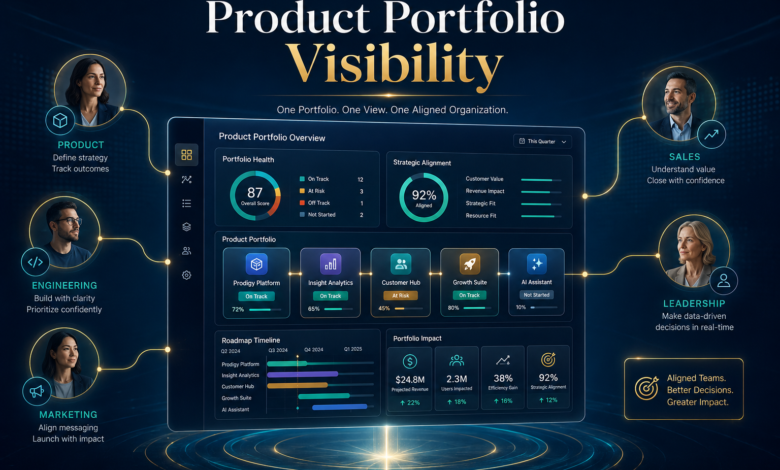
Seventy-three percent of the time companies with poor portfolio visibility make decisions with incomplete information. Each group within an organization has a piece of information that it cannot see in the context of the entire portfolio of features and products that the organization is building. In many cases, this inability to make complete decisions regarding development causes significant problems.
Most negative effects on customers from a poorly managed portfolio stem from a lack of alignment. Customers receive mixed messages about products and services. Some strategic initiatives fail. Other strategic initiatives are implemented without customers knowing about them.
The Silo Problem Runs Deeper Than Most Realize
So it’s not really just politics between departments. There are much deeper structural issues. In the meantime, Engineering is battling to fix tons of technical debt while Marketing launches a campaign for a new feature that won’t be ready for months, while the sales force is telling customers that a particular capability is available when reality is that product has long since deprioritized it.
Each team is trying to do their best with the information they have. If a team doesn’t have complete Portfolio Visibility then they will make suboptimal decisions. The aggregate of these individual decisions will typically have a net negative effect on the organization as a whole.
Information Hoarding as a Survival Mechanism
Information can become a means to an end for a team by withholding information from other teams within an organization in order to maintain control and to avoid unwanted involvement by other teams or influence from other teams. For example, product managers guard their product roadmaps for a number of reasons, not least that they are flexible and can change for a number of reasons. Engineering teams withhold information about the technical constraints that they are working under for fear that others will engage in premature optimization activities.
Of course, information hoarding can be useful to Product Managers to keep some flexibility. However, collectively, all the teams could make better decisions if they only had all the information they need to do so. Information flow leads to better decisions.
Data Without Context Creates New Problems
Better decisions are made by gathering information on a company’s product portfolio. Additional reports and more meetings are typical consequences of an organization striving for better product portfolio visibility. However, more data also creates new problems. The most important problem is to interpret all the information, which in the end takes up most of the time of the decision maker.
Changes in conversion rates of qualified leads in the CRM system may also decrease in the short term for reasons that have nothing to do with the sales process. For example, new product features that have recently been introduced into the portfolio may, in the short term, attract less qualified leads than expected. In the long term, as the market becomes better educated about the new feature set, conversion rates of qualified leads will actually increase in the future.
Rather than having the executive to dig through many reports to find the information needed to make a decision, the organization can simply query the portfolio to find the information needed for that specific decision.
Real-time Decision Making Requires Real-time Information
While most organizations can develop product within a few quarters, currently product is being developed and released within weeks. The need for information to flow through an organization and facilitate the correct decision regarding a product portfolio has increased significantly.
Roadmaps and release plans need to be live so that they don’t quickly become irrelevant to the fast moving team executing on them. Quarterly business reviews don’t arrive in time to impact the current round of decisions. That’s not to say that implementing systems to realize the implications of the portfolio in real time as decisions are being made is easy. It’s not. But it is a prerequisite to gaining the insights needed to make better collective decisions.
Stakeholder Alignment Through Shared Understanding
A number of the problems that product management perceive as problems with the portfolio are actually problems that other stakeholders perceive as problems with the definitions that product management use to manage the portfolio. Thus, what engineering perceives as ‘technical debt’ may be perceived by customer success managers as ‘quality issues’ and by sales managers as ‘a competitive disadvantage’.
When information is visible in the portfolio it does not have to be visible in the same way to every stakeholder. Rather information must be visible in a way that is most relevant to each different function. However that information must also remain consistent; in other words all the different views of the same information must be based on the same underlying portfolio data. The challenge therefore is to create the right portfolio tools in order to surface that information in the appropriate way for each group of stakeholders.
The best product portfolio visibility implementations create a shared mental model of what is happening in the market and, with that information, support the organization to make the very best decisions.
Moving Beyond Status Updates
Traditional portfolio management typically reports out the status of features in development for the product. In other words, the typical questions for a portfolio management tool would be: what is done, what is not finished on time, what is at risk, and so on. These are all backward looking questions.
Better portfolio visibility surfaces more than just status updates for your product portfolio. The issues that you need to face as a company and the opportunities that are presented by new feature sets all surface through a superior portfolio visibility tool. This allows you to ask and answer a set of predictive questions, such as: Which set of new features will deliver the greatest value – and possibly even the greatest and most unexpected value? What is the greatest opportunity cost to your organization by virtue of a current constraint on resources? How will the markets change and how will you and your overall product portfolio adapt as a result.
Implementation Principles That Actually Work
Your implementation of portfolio visibility needs to be such that it can be used as teams go about their work within existing workflows. It needs to surface information at the point of the decision rather than having teams go look for it. As I said earlier, Visibility is a means to an end. The end is better decisions. And, better decisions can often be had by less information being presented more clearly than by lots of information being presented in a raw and unorganized fashion.
Visibility is a means to an end. The end is making better and faster decisions. Less information that is presented in a clearer fashion is equally as valuable as more information presented in a less clear fashion.
An organization that develops and implements Portfolio Visibility in a sustainable manner will gain a sustainable competitive advantage. Decisions will be made faster and better, the organization will be able to adapt to market changes in time and with great precision, and it will utilize its available resources most efficiently.
Go build out your portfolio visibility in a methodical fashion to gain competitive edge through better decision making or continue down the path of making out critical product decisions with little to no information to make said decisions with. The market will not wait for you to figure out the proper steps.