In-House vs Outsourced Office Cleaning: Which Is Better for Your Business?

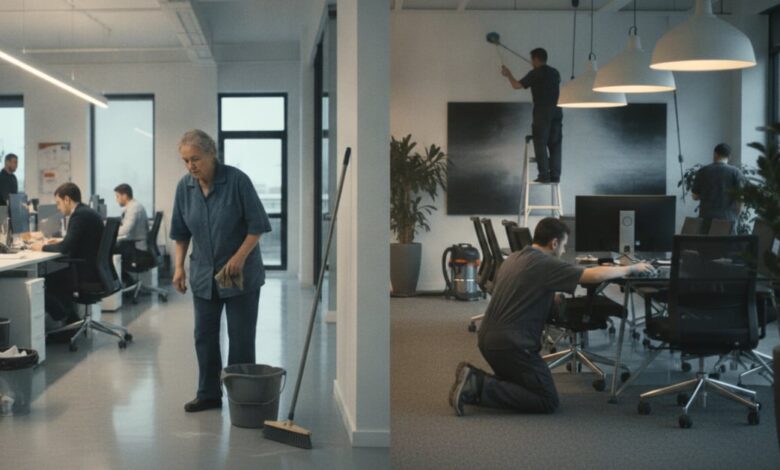
For most facilities managers, employing an internal cleaning staff offers a reassuring sense of control, allowing for immediate, face-to-face adjustments to daily schedules.
However, as the workplace becomes more sophisticated, an in-house operation can encounter its limits. You might find that despite internal inspections, certain high-value assets show unintended wear or that the overall depth of the cleaning no longer meets your changing expectations. This is no reflection of poor effort. Rather, it indicates a need for a more strategic approach.
Modern commercial spaces often require expert maintenance, such asset-specific chemical usage and strict compliance protocols that fall outside the scope of standard housekeeping.
This guide explores the practical differences between an in-house setup and outsourced or hybrid commercial cleaning models.
Cost of In-House Office Cleaning vs Cost of Outsourced Office Cleaning
A flat hour-based wage, on rare occasions, reflects the true picture of a modern workspace. After all, how can a single rate account for environments that differ in total? Office cleaning services’ true cost depends on three main factors.
The Size of Your Premises
Consider a sprawling, multi-floor corporate headquarters compared to a compact administrative hub or a small private office. The sheer square footage dictates a complex cleaning schedule. In a large building, tasks must be staggered across different zones to ensure staff are not disturbed during working hours.
Then, you must account for physical assets. Expansive premises often feature long stretches of porous natural stone flooring, large architectural glazing or high-level ducting. You cannot maintain these areas with standard mops and off-the-shelf detergents. They require commercial-grade scrubber-dryers and precise, pH-neutral chemicals.
Into the bargain, large offices are dynamic. What happens when an unexpected all-hands meeting or a sudden board-level visit is called in the main conference suite? A small in-
house team often struggles to pivot right away across a massive floor plan to prepare a room at short notice without abandoning their regular daily duties.
The Nature of Your Daily Operations
The rhythm of your working day also shapes your operational costs. Some offices run on a predictable nine-to-five schedule where cleaning hours remain fixed. But consider a high pressure trading floor. Here, the daily grind shifts, making the cleaning schedule hit-or miss.
The physical assets in these high-footfall spaces, such as bespoke deep-pile carpets or communal breakout furniture, endure day in, day out wear and tears from constant movement and spills. If the team hosts an unexpected late-evening networking event or a last-minute project sprint, you, out of nowhere, need an ad hoc, out-of-hours turnaround.
Paying an internal employee for these fluctuating hours often leads to a false economy. You either pay for idle time during quiet periods or you scramble to arrange overtime at a premium when the operational pace suddenly changes.
Your Specific Sector
Your industry, with zero tolerance, governs your hygiene requirements. A private medical clinic and a corporate law firm might occupy the exact same square footage, yet the scope of work and therefore the financial outlays differ at a massive level.
In regulated sectors, the schedule is controlled by compliance. Deep cleaning often has to happen late at night to protect patient privacy or attorney-client privilege. The physical assets involved are also sensitive.
A law firm might house extensive IT infrastructure and server rooms that require secure, anti-static cleaning. Meanwhilst, the clinic is bound by strict hygiene compliance, requiring clinical-grade disinfection across all surfaces and secure biological waste management.
To see exactly where the financial differences lie, you must look past the basic hourly rate. When you break down the operational realities, the cost structures of the two models look entirely different.
Cost Breakdown: In-House vs. Outsourced Office Cleaning
| Cost Factor | In-House Cleaning Cost | Outsourced Contract Cleaning Cost |
| Labour and Statutory Benefits | You pay the base hourly wage plus National Insurance, a 3% pension contribution, sick pay and 5.6 weeks of paid holiday. | You pay a single, predictable monthly fee that covers all wages, taxes and statutory employment benefits. |
| Equipment and Consumables | You absorb the upfront capital cost for commercial vacuums and scrubber-dryers, plus ongoing repair and supply costs. | Equipment and supplies are included in the contract, sourced by the provider at cheaper trade prices. |
| Staff Absence and Cover | You pay a premium for emergency overtime or temporary agency staff when your cleaner takes leave or falls ill. | The provider supplies trained standby cover at no extra charge, ensuring zero disruption to your daily operations. |
| Compliance and Insurance | You fund internal COSHH training and risk assessments and you may face higher business insurance premiums. | The provider assumes full HSE liability, covering their own training, safety documentation and insurance. |
When to Rely on In-House Cleaning versus a Hybrid Outsourced Approach
Likewise, the cost analysis is determined by specific sectors, nature of the operations and the size of the premises, determining the right model also depends on the scale and nature of your business.
When to Maintain an In-House Setup
If you operate a small office or a lean startup managing less than 1,000 square feet, an in house part-time cleaner is often sufficient. The administrative reach is small enough that managing basic supplies and a simple routine does not distract from core business activities.
The Hybrid Model for Scaling SMEs
However, for an SME expanding into larger premises or dealing with expensive office fit outs, a standalone in-house cleaner suffices once in a blue moon. Scaling businesses often find success with a hybrid approach: retaining an internal staff member for light upkeep, such as emptying bins and managing the dishwasher, whilst bringing in an
outsourced commercial cleaning service for deeper and special work such as window and facade cleaning or IT and workstation hygiene.
Strategic Hybrid Approach for Regulated Industries
You must hire a commercial cleaning company if your premises operate under strict regulations. Therefore, choosing a hybrid model in sectors like law or finance is rarely an issue of trust. Instead, it is simply about avoiding interruption during working hours.
In a busiest, secure office, an in-house cleaner is ideal for daytime tasks. They can tidy the boardroom between private meetings or manage the kitchen without getting in the way of your staff a; long with outsource team managing the heavy out-of-hours work, such as deep cleaning washrooms, scrubbing floors and removing deep stains on a monthly bases or ad hoc planning. This approach keeps your office spotless and fully compliant, without ever interrupting your daily operations.
Which Approach Is Saving Your Cost and Why?
Industry research from the International Facility Management Association (IFMA) indicates that running an in-house cleaning operation can cost businesses around 25% more than outsourcing. However, this saving is not a universal rule. It depends on your scale and the model you choose.
For a small business, hiring a commercial cleaning agency is rarely the most cost-effective route. Paying for a part-time, in-house cleaner for a few hours a week keeps your overheads low and suits a simple working environment.
For large organisations and growing SMEs, relying on an internal team can become an expensive oversight. Hidden costs, such as purchasing and repairing industrial equipment, covering sick pay and sourcing specialist supplies erode budgets.
Partnering with a credible, outsourced provider delivers financial savings by eliminating unexpected expenses like repairs, as equipment and supplies are provided at a fixed flat fee within the Service Level Agreement (SLA).
What Is Included in Outsourced Office Cleaning?
A standard contract rolls several distinct elements into a single invoice:
Staff and continuity
The provider recruits, vets (including DBS checks where necessary) and trains the staff. If a cleaner falls ill, the agency provides immediate cover from their wider pool of employees, ensuring no drop in hygiene standards.
Equipment and consumables
From colour-coded microfibre cloths to industrial vacuums and cleaning chemicals, the provider manages all inventory.
Service oversight
Rather than an office manager delivering performance feedback to a colleague, the outsourced firm assigns dedicated supervisors who conduct regular site audits to maintain service level agreements (SLAs).
Compliance Fulfillment with Outsourced Office Cleaning
Workplace safety legislation places a burden on employers. If an internal cleaner uses hazardous chemicals or is injured whilst reaching high surfaces, the business holds legal liability.
Outsourcing transfers this risk. Professional cleaning firms take full responsibility for compliance with the Health and Safety at Work Regulations 1999 and the Control of Substances Hazardous to Health (COSHH). They manage risk assessments, provide the correct personal protective equipment (PPE) and ensure chemicals are stored right.
It is also worth noting the impact on your business insurance. Storing industrial cleaning chemicals on-site often requires disclosure to your insurer, which can drive up premiums. An ISO 9001-certified commercial cleaning partner handles these hazards with precision, keeping your premises compliant and your premiums protected.
Which Office Assets Strictly Require Outsourced Cleaning Support?
Even if you prefer to keep tidying daily in-house, certain high-value assets demand an outsourced team prevent expensive damage.
• Server Rooms And IT Infrastructure
• Multiple Large or Expensive Floorings
• High-Level Glazing and Hard-To-Reach Areas
• HVAC And Air Vents
• Fabric Upholstery & Acoustic Partitions
• Costly Office Windows and Other Decorative Items
How Innovative Cleaning Services (ICS) Saves You Time and Money
Modern commercial cleaning is no longer just about mops and buckets. It is influenced by strict scheduling, compliance and ad hoc options. Innovative cleaning services provide a distinct advantage in all these three.
Achieve eco-friendly innovations with sterile, chemical-free water and low-VOC (volatile organic compound) cleaning products. With ICS, you can enhance your ESG (Environmental, Social and Governance) credentials, without taking on extra operational burdens or financial risks.