AI Smart Glasses in 2026: How Wearable AI Is Becoming an Everyday Tool

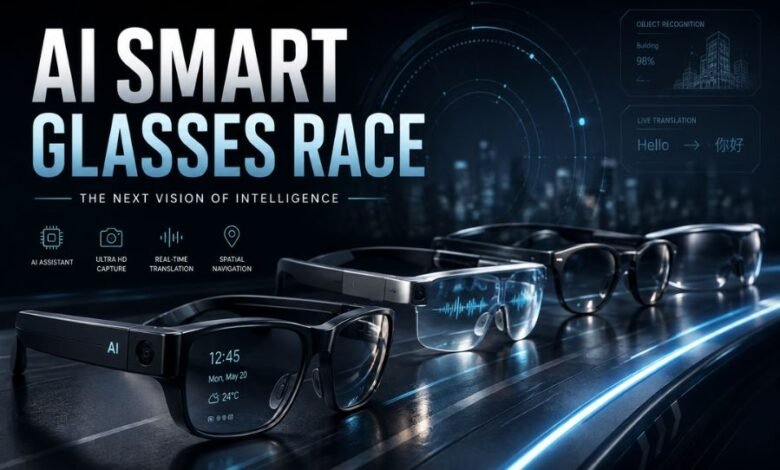
AI smart glasses are moving beyond simple cameras and audio playback into a new category of wearable computing. Instead of repeatedly reaching for a phone, users can ask questions, capture what they see, translate conversations, hear navigation instructions and receive contextual assistance through glasses designed to look increasingly similar to normal eyewear.
The technology has developed quickly. Meta has expanded its AI eyewear range, Google is preparing Gemini-powered Android XR glasses with major eyewear partners, and Snap is pushing further into true augmented reality with its new SPECS platform. The result is a rapidly developing market with several very different ideas about what smart glasses should become.
What Are AI Smart Glasses?
AI smart glasses are wearable glasses that combine traditional eyewear with technologies such as cameras, microphones, speakers, sensors, wireless connectivity and artificial intelligence. Some operate mainly through voice and audio, while more advanced models include displays that place digital information within the wearer’s field of view.
The AI element makes modern glasses different from earlier camera glasses. A multimodal assistant can potentially process spoken questions together with information captured by the glasses’ camera. This allows the device to respond to questions about objects, signs, places or other visible information instead of functioning only as a Bluetooth accessory.
Current products fall broadly into three categories: screen-free camera-and-audio glasses, glasses with smaller contextual displays, and full augmented-reality glasses designed to position digital objects or information within the physical environment. Meta itself now distinguishes between camera AI glasses, display AI glasses and augmented-reality devices.
How AI Smart Glasses Work
Cameras Give AI Visual Context
The camera is becoming one of the most important components of wearable AI. When supported by computer vision and multimodal AI, the system can interpret visual information alongside the user’s spoken request.
For example, Google’s upcoming Gemini-powered intelligent eyewear is designed to answer questions about things the wearer sees, interpret signs, identify surroundings and help with contextual tasks. Google has also demonstrated planned capabilities including taking photographs, translating visible text and providing information about nearby places.
This interaction model is significant because it reduces the need to describe everything manually. Instead of typing a long question explaining what is in front of them, a wearer may be able to simply look at something and ask about it.
Microphones and Open-Ear Audio Enable Hands-Free Use
Most mainstream AI glasses use microphones to detect voice commands and speakers positioned near the ears to deliver responses. Open-ear audio allows users to hear music, calls or AI responses while remaining more aware of surrounding sounds.
Meta’s current glasses use multi-microphone systems, voice-controlled Meta AI and open-ear speakers. Its 2026 Meta Glasses line also includes wind-noise reduction intended to improve calls, messaging and voice interaction in outdoor conditions.
Displays Create a Different Experience
Not every pair of AI smart glasses has a screen. In fact, many popular designs deliberately avoid one because displays add weight, power requirements and optical complexity.
Display-equipped glasses can provide information visually rather than forcing every interaction through audio. Meta Ray-Ban Display, for example, introduced a colour display alongside a separate Meta Neural Band, which interprets electrical signals associated with subtle muscle movements to provide another control method.
Full AR products go further. Snap’s 2026 SPECS use see-through displays with a 51-degree field of view and are designed to place interactive digital elements into the physical environment.
Why AI Smart Glasses Matter More in 2026
The most important development is not simply that glasses are becoming more powerful. They are becoming more practical.
Meta introduced a new Meta Glasses range with 26 styles, prescription-lens compatibility, more than eight hours of stated battery life and a charging case offering up to 40 additional hours. The glasses start at $299 in the United States and integrate Meta’s latest AI capabilities.
Meanwhile, Ray-Ban Meta Gen 2 increased typical-use battery life to as much as eight hours and added 3K Ultra HD video capture, according to Meta. These changes address two basic problems that have held wearable technology back: devices need enough endurance for regular use and need to look acceptable enough that people actually want to wear them.
Google is approaching the market through Android XR. At Google I/O 2026, the company said its first audio-focused intelligent eyewear would arrive in autumn 2026 through partnerships involving Samsung, Gentle Monster and Warby Parker. Gemini-powered functions are expected to include navigation, messaging, photo capture, contextual questions and translation.
The Most Useful AI Smart Glasses Features
Contextual AI Assistance
Context may become the defining feature of wearable AI.
A smartphone assistant usually waits for users to supply information. Smart glasses can potentially combine what the wearer says with what the camera and sensors detect. That creates opportunities for identifying objects, interpreting signs, answering questions about surroundings or finding information relevant to the immediate situation.
Meta says its latest AI glasses can better understand what the wearer is seeing, while Google’s Gemini eyewear is being designed around similar visual-context capabilities.
Translation
Translation is particularly well suited to glasses because conversations and written information happen directly in front of the wearer.
Google says its upcoming intelligent eyewear can translate speech and visible writing, including menus and signs. Meta has also expanded live translation on its AI glasses and announced support for additional languages in 2026.
Hands-Free Photography and Video
Smart glasses provide a first-person camera angle without requiring the wearer to hold a phone.
This can be useful for travel, sports, family moments, demonstrations and tasks where both hands are occupied. Meta’s current Ray-Ban and Oakley models combine voice-controlled capture with cameras, while Ray-Ban Meta Gen 2 supports 3K video.
Navigation and Everyday Tasks
Navigation could become one of the strongest practical uses of AI glasses. Audio-only models can provide spoken turn-by-turn guidance, while display glasses can potentially place directional information directly within the wearer’s view.
Google says its Android XR glasses will know the wearer’s location and direction of travel to provide navigation guidance. Meta has also announced pedestrian navigation for its displayless AI glasses.
AI Smart Glasses and Accessibility
Wearable AI could provide meaningful assistance beyond entertainment and productivity.
Because smart glasses can combine visual input with spoken output, they may help some blind and low-vision users obtain information about documents, objects and surroundings. Meta has been testing and supporting accessibility-related applications, including programs involving blind veterans and organizations experimenting with AI eyewear for independent living and workplace assistance.
The technology should not be treated as a universal accessibility solution, but hands-free contextual assistance demonstrates why smart glasses may eventually serve more purposes than conventional consumer gadgets.
Privacy Remains One of the Biggest Challenges
A wearable camera naturally creates concerns for people standing near the wearer. Someone looking at a pair of normal-looking glasses may not immediately know whether a photograph or video is being recorded.
Meta uses a front-facing capture LED on its AI glasses. The company says the light flashes during photography and continues blinking while video is recorded. On newer models, blocking or tampering with the LED can disable camera capture.
Snap has taken a similar approach with SPECS, which include a recording indicator. Snap also says its system prioritises on-device processing and provides controls over what information is stored, synchronised, shared or deleted.
Indicators help, but responsible behaviour still matters. Users should consider where recording is socially acceptable and understand the privacy settings, data practices and permissions associated with their particular device.
Current Limitations of AI Glasses
AI smart glasses have improved significantly, but they are not replacements for smartphones yet.
Battery capacity is restricted by the need to keep frames relatively small and comfortable. Display-based AR glasses face even greater power demands. Snap’s SPECS, for example, are rated for up to four hours of mixed use, while the charging case extends total use through additional charges.
AI responses can also be incorrect. Visual recognition may misunderstand an object, text or situation, so information involving safety, health, money or other important decisions should not be accepted without verification.
Comfort is another factor. Ordinary glasses are lightweight and simple, whereas cameras, processors, batteries, speakers and displays add weight and complexity. Snap’s display-focused SPECS weigh 132 or 136 grams depending on size, illustrating the engineering trade-off required for more capable AR hardware.
What to Consider Before Buying AI Smart Glasses
The right product depends heavily on the intended use.
For everyday photography, calls, music and voice assistance, lightweight screen-free glasses may be more practical. Athletes may prioritise secure fit, weather resistance and fitness integrations. Users who want visible notifications, directions or information should examine display models instead.
Before purchasing, compare:
- Battery life and charging-case capacity
- Camera and video quality
- Prescription-lens availability
- Weight and frame comfort
- AI assistant capabilities
- Phone compatibility
- Translation and navigation support
- Privacy controls
- Water and dust resistance
- Availability of software updates
Features can also differ by language and region, so checking what actually works in the country where the glasses will be used is more useful than relying only on the headline feature list.
Where AI Smart Glasses Are Heading Next
The industry is increasingly dividing into two paths.
One path focuses on glasses that remain almost indistinguishable from ordinary eyewear while providing AI through cameras, microphones and audio. Meta’s expanding portfolio and Google’s forthcoming audio glasses strongly support this approach.
The second path aims to create a true spatial computer. Snap’s SPECS already combine hand tracking, AI assistance, displays and spatial applications, while Meta continues developing AR technology beyond its current display glasses.
The long-term winner may ultimately combine both ideas: glasses light and attractive enough for daily wear, but capable of showing useful digital information only when it is needed.
Conclusion
AI smart glasses have entered a far more practical stage in 2026. Cameras, open-ear audio, multimodal assistants, translation and hands-free capture are already becoming established capabilities, while display-based systems are pushing wearable computing toward augmented reality.
Meta is expanding consumer-ready eyewear, Google is bringing Gemini to Android XR glasses, and Snap is developing a more immersive spatial-computing approach.
Important obstacles remain, particularly battery life, privacy, comfort and the reliability of AI-generated answers. Even so, the direction is clear: AI is moving away from being something accessed only through a phone or computer and toward technology that can understand what a person is seeing and provide assistance without demanding constant attention to a screen.
(FAQs)
What can AI smart glasses do?
Depending on the model, they can capture photos and videos, play audio, handle calls, answer voice questions, translate languages, provide navigation and use cameras to give an AI assistant visual context. More advanced models can display digital information or augmented-reality content.
Do all AI smart glasses have a display?
No. Many popular AI glasses use cameras, microphones and open-ear speakers without a visible screen. Other devices, including Meta Ray-Ban Display and Snap SPECS, provide visual information through integrated displays.
Can AI smart glasses work with prescription lenses?
Some models can. Meta says its 2026 Meta Glasses are compatible with prescription lenses, while Snap says removable inserts allow SPECS to support a range of prescriptions. Compatibility varies between products and prescriptions.
Are AI smart glasses always recording?
Not necessarily. Recording normally requires the wearer to activate the camera. Meta’s current glasses use a visible capture LED when photos or videos are being recorded, while Snap also uses a recording indicator on SPECS.
Will AI smart glasses replace smartphones?
Not in the immediate future. Current glasses still rely on compromises involving battery capacity, displays, processing, comfort and software functionality. Their strongest near-term role is likely to be as a hands-free companion that reduces how often a user needs to take out a phone.