How Smart Training Technology Is Changing Recreational Tennis in 2026

Smart training technology is changing recreational tennis by making practice more measurable, repeatable, and easier to organize without constant coaching supervision.
In 2026, recreational players have access to tools that were once associated mainly with professional training environments. Video analysis, wearable sensors, automated ball feeding, smartphone apps, and data-based practice tracking can now support everyday sessions.
The biggest change is not simply that players have more technology. It is that technology can help turn an unstructured hour on court into a focused training session with a clear objective.
What Does Smart Tennis Training Mean?
Smart tennis training uses technology to improve how a player plans, performs, records, or evaluates practice.
It can include:
- smartphone video analysis
- stroke and movement tracking
- programmable ball feeding
- wearable fitness sensors
- serve-speed measurement
- digital practice logs
- court-position analysis
- automated drill sequences
Not every player needs every tool.
For recreational tennis, the most useful technology is usually the technology that answers a specific question.
A player trying to improve forehand consistency may need repeatable feeds and video. Someone working on conditioning may benefit more from movement and heart-rate data. A player rebuilding a serve may simply need a tripod, target zones, and slow-motion recording.
The objective should determine the technology, not the other way around.
Video Has Made Technical Feedback More Accessible
One of the most significant changes in recreational training is the widespread use of smartphone video.
Players can record a few forehands, backhands, serves, or volleys and immediately review what happened.
Video can reveal details that are difficult to notice while hitting, including:
- preparation timing
- contact-point location
- spacing from the ball
- balance through the stroke
- recovery after contact
- racket path
- court position
This is particularly useful because the movement a player feels is not always the movement that actually occurred.
For example, a player may believe the racket preparation is early enough. Video may show that the backswing begins only after the ball crosses the net.
That observation creates a specific training objective for the next set of repetitions.
Automated Feeding Makes Repetition More Controlled
Repetition is essential when a player is learning or refining a movement.
With a hitting partner, however, every incoming ball is slightly different. That unpredictability is valuable for match preparation but less useful when the immediate goal is isolating a technical pattern.
Automated feeding creates a more controlled environment.
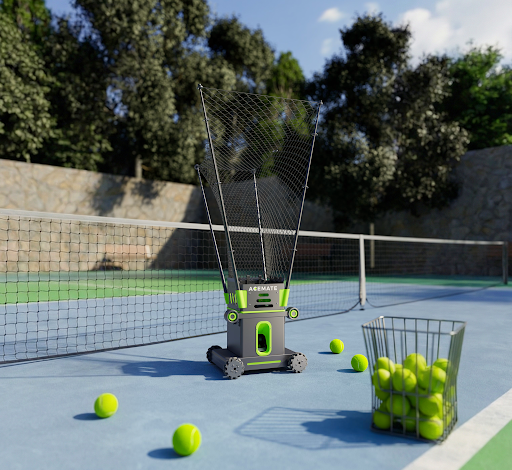
A tennis feeder machine can provide repeated balls while allowing the player to concentrate on preparation, spacing, contact, direction, and recovery.
For example, a player working on a crosscourt forehand can establish a repeatable sequence:
- split step
- move into position
- hit toward the crosscourt target
- recover toward the center
- prepare for the next ball
The value is not simply receiving more balls. It is receiving enough controlled repetitions to practice the same movement pattern deliberately.
Smart Practice Is Moving Beyond Stationary Repetition
Modern training increasingly treats ball feeding as a way to practice movement patterns rather than just strokes.
Instead of standing in one location and hitting 50 identical forehands, players can structure drills around realistic court movement.
Examples include:
Alternating Forehand and Backhand
Balls alternate between two positions along the baseline.
The player must recover after every shot and prepare for the opposite side.
Short Ball to Approach Shot
A deeper ball is followed by a shorter feed.
The player moves forward, hits an approach shot, and continues toward the net.
Defensive Ball to Recovery
The first ball pulls the player wide.
After hitting, the player must recover quickly before receiving the next feed.
Inside-Out Forehand Pattern
The player moves around the backhand side and attacks toward a designated target.
Each drill connects stroke production with movement and decision patterns that appear during points.
Data Can Make Practice More Objective
Recreational players often evaluate practice based on feeling.
They may finish a session thinking they played well or poorly, but those impressions can be influenced by a few memorable shots.
Simple data can create a more objective picture.
Players can track metrics such as:
- successful shots out of 20 attempts
- percentage of balls landing beyond the service line
- first-serve percentage
- number of serves reaching a target zone
- consecutive rally balls completed
- successful approach-and-volley sequences
These measurements do not require advanced analytics.
A notebook or smartphone note can be enough.
For example, a player attempting 30 crosscourt forehands might record how many land in the intended target area. Repeating the same drill two weeks later provides a direct comparison.
That makes progress easier to identify.
AI Analysis Is Expanding What Players Can Review
Artificial intelligence is becoming more visible in sports analysis, including tennis.
Depending on the platform, AI-assisted systems may help identify strokes, track ball placement, organize video clips, or highlight movement patterns.
For recreational players, the practical benefit is efficiency.
Reviewing an entire hour of practice manually is rarely realistic. Automated tools can help narrow attention to specific moments or categories of shots.
However, AI-generated information still needs context.
A technical suggestion that works for one player may not be suitable for another player’s movement pattern, physical capabilities, or tactical goals.
For significant technique changes, qualified coaching remains valuable.
Technology can identify patterns. Coaching helps determine what those patterns mean and what should change.
Wearables Can Connect Tennis Skill With Physical Training
Tennis performance depends on more than racket technique.
Players repeatedly accelerate, decelerate, change direction, recover, and produce explosive movements.
Wearable devices can help recreational players understand the physical demands of a session.
Common measurements may include:
- session duration
- heart rate
- distance covered
- movement intensity
- recovery time
- training load
These metrics can be useful for comparing different types of tennis sessions.
A doubles match, intensive singles practice, serving session, and ball-feeding workout can place very different demands on the body.
Tracking those differences can help players organize training more intentionally.
Smart Tools Work Best With Specific Practice Goals
Technology becomes less useful when players collect information without knowing what to do with it.
A better approach is to begin every session with a question.
For example:
Goal: Improve crosscourt forehand depth.
Useful tools:
- ball feeding
- deep target zones
- smartphone video
- successful-shot tracking
Goal: Improve first-serve placement.
Useful tools:
- service targets
- video
- percentage tracking
- optional speed measurement
Goal: Improve baseline movement.
Useful tools:
- alternating feeds
- cones
- movement tracking
- video from behind the baseline
The goal determines what should be measured.
Technology Does Not Replace Match Play
Controlled practice and competitive tennis develop different skills.
Technology is particularly effective for repetition, measurement, technical review, and drill organization.
Match play develops skills that are harder to reproduce in a controlled environment, including:
- opponent recognition
- tactical decision-making
- score pressure
- anticipation
- adapting to unexpected balls
- emotional control
For that reason, recreational players generally benefit from combining structured training with real competition.
A player might use one session to develop a stroke pattern and another to test that pattern during points.
This creates a useful cycle:
practice, test, evaluate, adjust, repeat.
A Simple Smart Training Session
A recreational player does not need a complicated technology setup.
A 45-minute session could include:
5 minutes: dynamic warm-up and shadow swings
15 minutes: repeated groundstroke pattern with target zones
10 minutes: movement-based drill
10 minutes: serve placement with percentage tracking
5 minutes: video review and practice notes
The important step comes at the end.
Record what worked, what remained inconsistent, and what should be repeated in the next session.
Over time, these small records can reveal more than relying on memory alone.
Frequently Asked Questions
What is smart tennis training?
Smart tennis training uses tools such as video, sensors, automated ball feeding, apps, and performance tracking to make practice more structured and measurable.
Do recreational players need advanced tennis technology?
No. A smartphone, tripod, targets, and a simple training log can already provide useful feedback. Additional technology should support a specific practice objective.
Can technology improve tennis technique?
Technology can help players observe and measure technique more clearly. Video and repeated feeds are particularly useful for identifying movement patterns. Coaching may still be important when making major technical changes.
Are ball-feeding systems only useful for beginners?
No. They can support beginners learning basic consistency as well as experienced players practicing movement patterns, shot combinations, direction, and repetition.
Final Takeaway
Smart training technology is making recreational tennis practice more structured rather than simply more technical.
Video can improve observation. Automated feeding can create controlled repetition. Wearables can measure physical demands. Data can show whether a drill is actually improving.
The most effective approach is still simple: define a tennis problem first, choose the tool that helps address it, and measure whether the practice produces a better result.