How Community-Based Bitcoin Mining Is Changing the Way People Participate

Bitcoin mining has changed significantly since the early days when individuals could run mining software on an ordinary computer. Today, successful mining usually involves specialised computing power, electricity, technical setup and access to mining infrastructure.
For many people interested in Bitcoin, these requirements create a difficult starting point. Buying and maintaining equipment can be costly, while understanding hash power, mining pools, wallets and network difficulty can take time.
Community-based mining platforms are trying to simplify this process. Instead of expecting every participant to build a complete mining operation alone, these platforms connect users through a shared ecosystem.
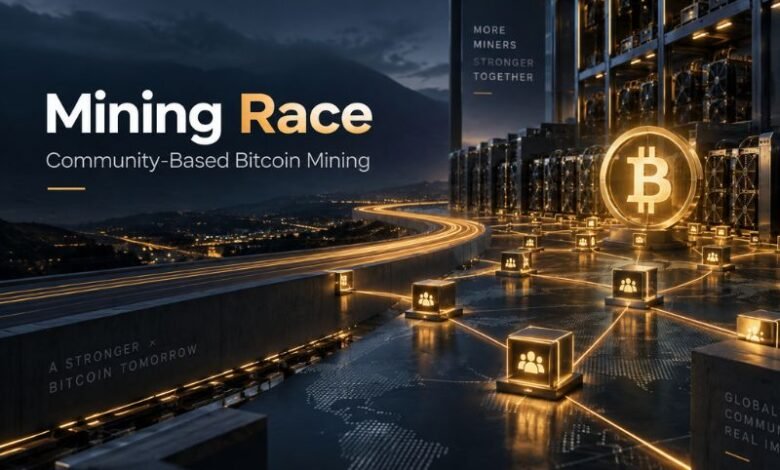
One example is Mining Race, which presents itself as a community-based Bitcoin mining programme built around a connected Mining Grid. Its model combines individual mining participation with a network structure designed to bring miners together.
Why Bitcoin Mining Can Be Difficult for Individuals
Bitcoin mining helps process transactions and secure the Bitcoin blockchain. Miners contribute computing power as part of the Proof-of-Work process, competing to successfully add new blocks to the network.
The basic concept sounds straightforward, but operating mining hardware independently can be more complicated.
A miner may need to consider equipment costs, electricity consumption, cooling, maintenance, internet connectivity, mining-pool configuration and wallet management. Bitcoin’s network difficulty can also change, which means mining results are never completely fixed.
These factors have encouraged the development of hosted mining services, mining pools and community-based systems that aim to make participation easier.
The main idea is simple: users should not necessarily have to manage every technical detail themselves.
What Is Community-Based Bitcoin Mining?
Community mining brings multiple participants into a connected mining ecosystem.
Rather than treating every miner as an isolated participant, a community model can organise users, mining power and reward systems within a shared network.
Mining Race calls its network the Mining Grid. According to the platform, the Mining Grid consists of connected positions known as Spots. Participants in the ecosystem are referred to as Racers.
The system is intended to give participants a structured position within the community while connecting mining activity across the wider network.
This creates a different experience from simply purchasing a mining machine, switching it on and waiting for mining results.
Understanding the Mining Grid
The Mining Grid is one of the central parts of the Mining Race model.
A user obtains a position known as a Spot, which acts as their digital position within the Mining Race community. The platform states that a Spot allows users to participate more fully in its ecosystem and invite other participants. Spots are accessed through the platform and require purchase and renewal.
The Grid is designed to connect participating miners rather than leaving them as completely separate operators.
This does not mean that every participant will receive identical mining results. Actual mining outcomes can depend on factors such as available hash power, Bitcoin network difficulty, Bitcoin’s market price and the specific activity or eligibility requirements of the platform.
For readers who want a closer explanation of the structure, the official guide to how Mining Race works explains the Mining Grid, Spots and its reward structure in more detail.
How Does a Spot Fit Into the System?
A Spot can be viewed as a participant’s position inside the Mining Grid.
According to Mining Race, securing a Spot enables a Racer to connect with the ecosystem and participate in the community structure. The platform’s newer material also describes different Spot tiers that determine how much eligible mining capacity can be connected.
This is important because a Spot should not automatically be confused with guaranteed Bitcoin income.
Mining still depends on computing power and wider network conditions. The platform itself states that mining rewards are variable rather than fixed or guaranteed.
Anyone considering a mining platform should therefore understand exactly what is being purchased, what mining capacity is included or connected, what fees may apply and how rewards are calculated.
Miner Earnings and the Grid Bonus
Mining Race describes two important reward-related concepts: Miner Earnings and the Grid Bonus.
Miner Earnings are connected to the mining capacity associated with a participant’s setup. In simple terms, this is the mining side of the system.
The Grid Bonus relates to eligible activity within the connected Mining Grid. The platform’s current explanation describes it as a participation-based community reward rather than a fixed return.
This distinction matters.
Bitcoin mining revenue can change over time. Network difficulty, Bitcoin prices, operating costs and available hash rate can all affect mining economics. Community bonuses may also depend on eligibility requirements and network activity.
For this reason, potential participants should avoid assuming that historical examples or promotional figures represent future results.
Bringing Competition Into Bitcoin Mining
Mining Race also introduces a competitive element through its racing concept.
Its website describes Cores Racing as an additional layer of participation in which eligible mining units can enter races for a chance to receive additional rewards.
The platform has described formats including Sprint Race and Block Race.
Sprint Race is intended for newly activated eligible Mining CORES and operates on a scheduled basis, while Block Race provides ongoing competition opportunities for eligible active CORES.
This gamified approach makes the experience different from traditional mining dashboards that focus almost entirely on hash rate and payout statistics.
However, a chance to earn an additional reward is still a chance, not a guarantee. Competitive rewards should therefore be understood separately from ordinary mining output.
Why Simplicity Matters for New Mining Participants
Technical complexity remains one of the biggest barriers for people exploring Bitcoin mining.
Experienced operators may be comfortable configuring machines, choosing pools and managing hardware. Beginners often are not.
A platform that brings mining access, account management, wallet functions, educational resources and performance monitoring into one system may therefore make the process easier to understand.
Mining Race says its dashboard allows users to monitor elements such as hash power, mining rewards and active products. Its hosted-device model is also designed so that infrastructure requirements such as maintenance and monitoring can be managed through the platform rather than directly by every participant.
Convenience, however, should not replace research.
Users should still understand the service terms, costs, withdrawal requirements, wallet arrangements and risks before committing funds.
Security and Wallet Control Matter
Cryptocurrency participation always requires careful attention to security.
Mining rewards ultimately involve digital assets, which means wallet management is an important part of the process. Mining Race states that eligible rewards can be paid to a non-custodial wallet, with withdrawals available to an external Bitcoin address subject to applicable requirements.
A non-custodial structure can give users greater control over their assets, but it also means users need to take wallet security seriously.
Strong passwords, secure devices, careful handling of recovery information and awareness of phishing attempts remain essential.
No mining platform can remove the need for responsible cryptocurrency security practices.
What Should You Check Before Joining a Mining Platform?
Anyone researching community-based Bitcoin mining should look beyond marketing headlines.
Start by understanding how mining power is provided and whether you are buying hardware, renting capacity, subscribing to a service or participating through another structure.
Next, check the costs. These may include subscriptions, hosting, electricity, maintenance or other charges.
You should also understand how rewards are calculated, when withdrawals are available and whether minimum withdrawal limits apply.
Most importantly, look for clear risk disclosures.
Bitcoin mining does not provide guaranteed profits. Mining difficulty changes, Bitcoin prices fluctuate and operating conditions can affect returns. Even a professionally managed mining system remains exposed to these wider variables.
Mining Race itself states in its current materials that mining rewards are variable and that participation should not be treated as a guaranteed-return financial product.
The Bigger Picture for Community Mining
The idea behind community mining reflects a broader shift in the Bitcoin ecosystem.
Individual mining has become increasingly specialised. As a result, services that combine infrastructure, pooled participation and easier user interfaces may attract people who want exposure to the mining process without operating an industrial setup themselves.
Mining Race adds another layer by organising participants through its Mining Grid and combining mining activity with community participation and competitive features.
Whether this model suits a particular user depends on that person’s goals, budget, understanding of Bitcoin and willingness to accept mining-related risk.
What matters most is understanding the system before joining it.
Final Thoughts
Bitcoin mining is no longer simply about purchasing a machine and running it at home. The industry now includes large mining facilities, pools, hosted solutions and community-based platforms designed to make participation more accessible.
Mining Race represents one approach to that evolution. Its Mining Grid connects participants through Spots while combining mining activity, community features and additional participation-based rewards.
For newcomers, the structure may appear easier than managing an entire mining setup independently. Still, simplicity does not eliminate financial or technical risk.
Anyone interested in Bitcoin mining should research the platform carefully, understand all costs and conditions, and remember that mining results can change with Bitcoin price, network difficulty, available computing power and other market factors.
Community mining may make participation easier, but informed participation remains the most important starting point.