How to Choose the Right Watch Winder for Your Breitling

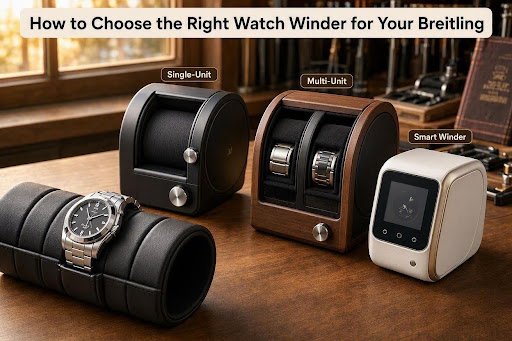
If you own a Breitling, you already know it isn’t the kind of watch you leave in a drawer. These are self-winding machines built to run continuously, and when they sit unworn for more than a day or two, the mainspring winds down and the watch stops. That’s a minor inconvenience for a simple three-hand model. For a Breitling with a perpetual calendar, moon phase, or chronograph complication, it can mean resetting several functions by hand every time you want to wear it again.
A watch winder solves this by keeping the watch in motion when it’s off your wrist, so the movement stays lubricated, the complications stay set, and the watch is ready the moment you pick it up. The tricky part is that not every winder suits every Breitling. Rotation direction, turns per day (TPD), and even the way the watch sits in the holder all affect whether the winder actually helps the movement or just spins it uselessly.
This guide walks through what actually matters when choosing a winder for a Breitling, how to find the right settings for your specific caliber, and what to avoid.
Why Automatic Watches Need Winding at All
An automatic movement uses a rotor that spins with the natural motion of your wrist. That motion winds the mainspring, which stores the energy that powers the watch. Once you take the watch off, the mainspring gradually unwinds, and depending on the caliber’s power reserve, the watch will stop anywhere from around 40 hours to several days later.
For a simple date function, restarting the watch is a two-second job. For Breitling’s more advanced calibers, such as those found in the Navitimer collection, it’s a different story. Some of these movements combine a chronograph with additional complications, and getting everything back in sync after a full stop can take several minutes of careful adjustment. Owners with more than one automatic piece, or with a Breitling they only wear occasionally, tend to find a winder pays for itself in saved time alone.
What “Turns Per Day” Actually Means
Every automatic caliber is designed around a specific number of rotor turns needed to keep the mainspring adequately wound without overwinding it. This is the TPD, or turns per day, setting on a winder.
Set the TPD too low, and the watch won’t get enough winding to stay fully powered, so it may run down between wears or lose accuracy. Set it too high, and you’re not damaging the watch (modern automatic movements have a slipping clutch that prevents mechanical overwinding), but you are adding unnecessary wear to the rotor bearings over years of use.
Breitling calibers vary in their TPD requirements depending on the movement architecture, so a universal winder setting doesn’t exist across the whole brand. This is exactly why checking the setting against your specific model matters more than picking a winder based on price or looks. If you’re specifically working with a Navitimer, the breitling navitimer watch winder worth considering reference is worth reading before you buy, since it lays out the settings by caliber rather than guessing from general Breitling advice.
Rotation Direction: Clockwise, Counterclockwise, or Both
The second setting that matters is rotation direction. Automatic movements are built with one of three winding mechanisms:
- Bidirectional — the rotor winds the mainspring in both directions
- Unidirectional clockwise — winding only happens when the rotor spins clockwise
- Unidirectional counterclockwise — winding only happens when the rotor spins counterclockwise
Most modern Breitling calibers use bidirectional winding, which makes life easier because a winder set to alternate directions (or run in either single direction) will still wind the watch correctly. Some older or specific in-house calibers are unidirectional, and running a bidirectional-only winder on one of these means half the rotation cycles do nothing useful. It won’t harm the watch, but it will winds it less efficiently than expected, which sometimes leads owners to wrongly assume the winder itself is faulty.
Checking your specific caliber’s winding direction before setting up the winder avoids this confusion entirely.
Matching the Winder to the Watch, Not Just the Brand
A common mistake is assuming any winder marketed for “luxury watches” or even labeled for Breitling generally will handle every reference correctly. In practice, Breitling’s range spans multiple movement families across the Navitimer, Superocean, Chronomat, and Premier lines, and TPD requirements differ between them. A winder needs to let you actually input a TPD and direction that matches your caliber, not just spin at a fixed factory default.
It’s also worth checking the physical fit. Breitling cases tend to run larger, and some models, particularly the Navitimer’s chronograph pushers and larger case diameters, need a winder with a deeper or wider holder so the watch sits securely without pressure on the crown or pushers.
If you’re comparing dedicated options built around these requirements, the official Aevitas Breitling Watch Winder range is designed with adjustable TPD and direction settings specifically to cover the brand’s different calibers, rather than a single generic mode.
Single vs. Multi-Watch Winders
If you own more than one automatic Breitling, or plan to add to your collection, it’s worth thinking about capacity early rather than buying a single-watch unit and replacing it later. Multi-watch winders let you set TPD and direction independently for each slot, which matters if your collection includes both a bidirectional three-hand watch and a unidirectional chronograph. Trying to run mismatched calibers on a single shared setting is one of the more common winder mistakes new owners make.
Storage capacity aside, a good multi-watch winder should also let each watch run on an independent timer, since not every watch needs winding every single day. A watch you wear twice a week needs far less winding time than one that sits unworn for a month.
Motor Quality and Noise
Cheaper winders often use lower-grade motors that produce a noticeable hum or vibration, which becomes a real issue if the winder lives on a nightstand or in a bedroom. Mabuchi motors are generally considered the standard for quieter, more consistent operation, and it’s a detail worth checking in the product specifications before buying rather than after the winder arrives.
Vibration also matters mechanically. A winder that jolts or shakes as it changes direction is putting unnecessary stress on the movement’s components over months of continuous use. A well-built winder should rotate smoothly with barely any audible sound at close range.
Setting Up a New Winder Correctly
Once you’ve picked a winder that matches your Breitling’s TPD and direction requirements, setup is straightforward:
- Fully wind the watch by hand or wrist motion for a few minutes before placing it in the winder, so it starts from a reasonably charged mainspring rather than empty.
- Set the TPD according to your caliber’s specification.
- Select the correct rotation direction (clockwise, counterclockwise, or bidirectional).
- Secure the watch in the holder so the strap or bracelet doesn’t press against the winding mechanism.
- Check the watch’s accuracy after 24–48 hours and adjust the TPD slightly if it’s running fast or slow.
That last step matters more than most people expect. Manufacturer TPD figures are a starting point, and small variations between individual watches (even the same caliber) mean a slight adjustment sometimes gets better long-term accuracy than the factory-recommended number.
Do You Actually Need a Winder?
Not every Breitling owner needs one. If you wear the same watch daily, your wrist motion alone keeps it wound, and a winder adds convenience rather than necessity. Winders earn their keep in a few specific situations:
- You rotate between several automatic watches and don’t want to reset each one before wearing it
- Your Breitling has a perpetual calendar or moon phase complication that’s tedious to reset
- You travel frequently and want the watch ready to go the moment you’re back
- You store the watch for extended periods and want to protect the movement’s lubrication from settling unevenly
If none of these apply, hand-winding or simply resetting the watch when you pick it up again is perfectly fine and won’t cause any harm.
For more general background on how automatic movements work and why servicing intervals matter alongside winding habits, the Worn & Wound explainer on mechanical movements is a solid, independent reference.
If you’re starting from scratch and want to browse the wider range of options before narrowing down to a specific caliber, Aevitas stocks winders across multiple brands and price points, which is a reasonable place to compare features side by side.
Final Thoughts
Choosing a winder for a Breitling isn’t about finding the most expensive option or the one with the most watch slots. It comes down to two numbers and one direction: the right TPD, the right rotation setting, and a holder that fits the case properly. Get those right, and the watch stays accurate, the complications stay set, and you save yourself the small but real annoyance of resetting a chronograph every time you switch watches. Get them wrong, and you’re either under-winding the watch or adding needless wear for no benefit.
Take the time to look up your specific caliber’s requirements rather than relying on generic settings, and a winder becomes a genuinely useful piece of equipment rather than an expensive shelf ornament.
FAQs
Do Breitling watches need a specific TPD setting? Yes. TPD requirements vary by caliber, so there’s no single number that applies across the whole Breitling range. Checking your specific movement’s specification is the only reliable way to set it correctly.
Will a winder overwind my Breitling? No. Modern automatic movements have a slipping clutch mechanism that prevents mechanical overwinding, regardless of how long the winder runs. Excessive TPD mainly adds unnecessary wear over time rather than damaging the watch immediately.
Can I use one winder setting for all my automatic watches? Not reliably. Different calibers require different TPD and rotation directions, so a shared setting works only if all your watches happen to share the same winding requirements. Independent settings per watch avoid the guesswork.
How long should I run a new watch on a winder before checking accuracy? 24 to 48 hours is usually enough to see whether the watch is running fast, slow, or on time, which lets you fine-tune the TPD if needed.
Is a winder necessary if I wear my Breitling every day? Not really. Daily wrist motion keeps the watch sufficiently wound on its own. A winder becomes more useful when you rotate between multiple watches or own a model with complications that are tedious to reset.